
Solutions
Built for the organizations carrying the most operational complexity.
EH Solutions is designed to resonate with every stakeholder in a health system — from the C-suite setting strategy to the department leaders running daily operations.
Who we serve
Two markets. One expansion path.
Health systems
Integrated delivery networks, academic medical centers, community hospitals, and multi-hospital organizations. These organizations face the greatest operational complexity, employ the largest workforces, and have the budget authority to invest in enterprise AI.
Specialty providers
Physician organizations, ambulatory surgery centers, behavioral health organizations, post-acute and home health, and government healthcare entities — a natural expansion market as operational sophistication grows.
6,100
U.S. hospitals — total addressable market
1,000
highest-value health systems — primary commercial focus
Land → Prove ROI → Expand
each new department is a beachhead for enterprise-wide adoption

Solutions by role
Every leader gets what they need.
Enterprise healthcare decisions require alignment at the executive level and buy-in from the teams doing the work every day. EH Solutions is designed to earn both.
CEO
Enterprise transformation, delivered without disrupting existing technology investments.
COO
Ownership of operational efficiency across every department, in one unified view.
CFO
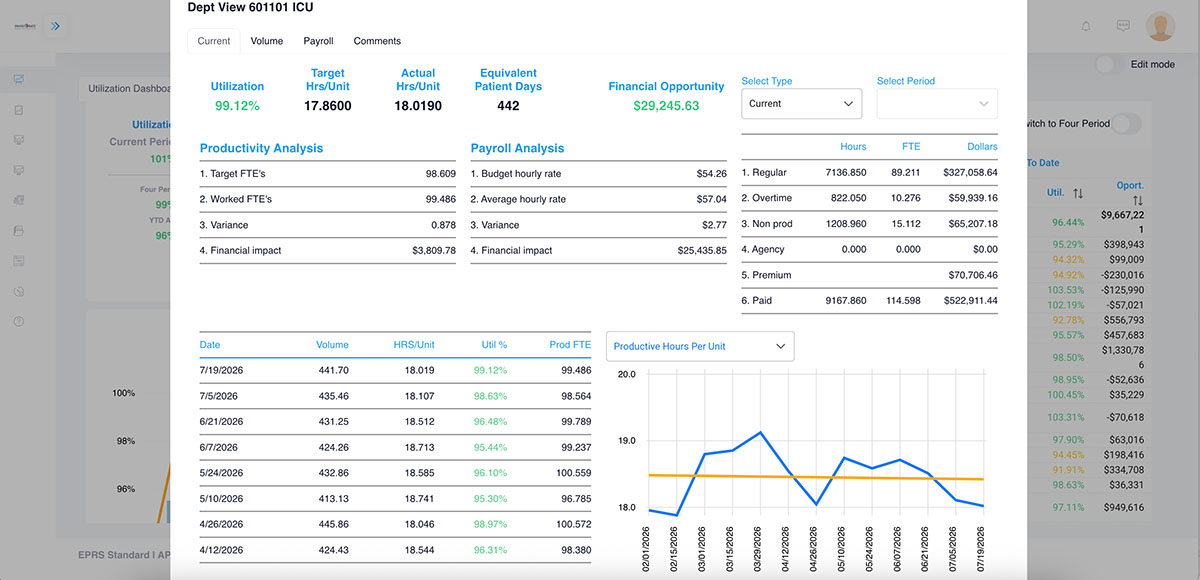
A measurable labor-cost and productivity ROI case, grounded in your own operating expense.
CIO
A digital strategy that integrates cleanly — FHIR, HL7, open APIs, no rip-and-replace.
CNO
Relief for clinical workforce burnout by removing repetitive administrative work.
Beyond the C-suite, VPs, department directors, and operational excellence leaders feel the pain of inefficiency most acutely day to day — and become the internal champions who prove EH Solutions' value before it scales enterprise-wide.
The ROI case
Measurable value across every operational domain.
Grounded in operational gaps documented in every U.S. health system today — not a speculative case.
Workforce productivity
Free clinical and operational staff from administrative tasks to focus on higher-value work — every FTE hour is a scarce resource.
Cost reduction
Automate manual workflows to cut labor costs and rework. Labor is 55–60% of operating expense, so even modest gains matter.
Operational efficiency
Standardize workflows across departments and facilities to eliminate costly process variation.
Decision velocity
Accelerate leadership decisions with real-time operational intelligence and executive dashboards.
Employee retention
Reduce burnout by eliminating repetitive, low-value tasks in the tightest labor market in a generation.
Compliance readiness
Turn documentation and reporting from a manual burden into a systematized operational output.
Getting started
Prove it in one department before you scale it enterprise-wide.
A focused pilot delivers visible results within 60–90 days — before you commit to a full enterprise rollout.